Boost converter

Schematic
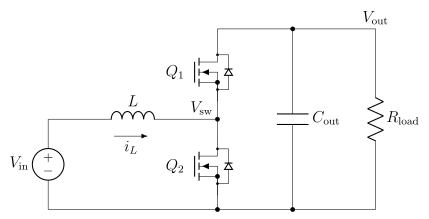
An input voltage source feeds an inductor into Vsw, the midpoint of two stacked N-channel MOSFETs. The high-side MOSFET connects Vsw to the output capacitor and load resistor. The low-side MOSFET connects Vsw to the shared return rail. The inductor current arrow points from the input toward Vsw.

Operating point

Switching timing
Rectification

Conduction mode
CCM
Duty cycle
75.0%
Switching frequency
200 kHz
Ripple factor
45.0%
Inductor RMS current
10.1 A
Q1 RMS current
5.0 A
Q2 RMS current
8.7 A

Waveforms

Inductor current iL

Inductor current in amperes over two switching periodsPeak current: 12.3 A. Average input current: 10.0 A. Valley current: 7.8 A. On time: 3.75 µs. Current fall (t2): 1.25 µs.

Switch-node voltage Vsw

Switch-node voltage in volts over two switching periodsOutput voltage: 48.0 V. Input voltage: 12.0 V. On time: 3.75 µs at 0.0 V. Current fall (t2): 1.25 µs at 48.0 V.

Governing equations

During the on time t1, the low-side switch Q2 is closed and the inductor current iL rises.

Vin=Lipeak−ivalleyt1V_{\mathrm{in}} = L\frac{i_{\mathrm{peak}} - i_{\mathrm{valley}}}{t_1}

During the current fall interval t2, the high-side switch Q1 is closed.

Vin−Vout=Livalley−ipeakt2V_{\mathrm{in}} - V_{\mathrm{out}} = L\frac{i_{\mathrm{valley}} - i_{\mathrm{peak}}}{t_2}

If operating in continuous conduction mode, the on and off intervals fill the switching period.

t1+t2=1fswt3=0\begin{gathered} t_1 + t_2 = \frac{1}{f_{\mathrm{sw}}} \\ t_3 = 0 \end{gathered}

Otherwise, if operating in discontinuous conduction mode, the inductor current stays at zero for an additional off time interval t3. In constant off-time mode, the Off-time setting covers both intervals t2 and t3.

t1+t2+t3=1fswivalley=0\begin{gathered} t_1 + t_2 + t_3 = \frac{1}{f_{\mathrm{sw}}} \\ i_{\mathrm{valley}} = 0 \end{gathered}

In steady-state, the average current through the high-side switch must equal the load current.

VoutRload=(ipeak+ivalley)t22(t1+t2+t3)\frac{V_{\mathrm{out}}}{R_{\mathrm{load}}} = \frac{(i_{\mathrm{peak}} + i_{\mathrm{valley}})t_2}{2(t_1 + t_2 + t_3)}